The MBLEx Exam: What It Is, How It Works and How to Prepare
The MBLEx (Massage & Bodywork Licensing Examination) is the 100-question, multiple-choice exam that 46 of the 49 regulated US jurisdictions use to license entry-level massage therapists. It is run by the Federation of State Massage Therapy Boards (FSMTB), delivered at Pearson VUE test centers, and gives you 110 minutes, one question at a time, with a pass-or-fail result.
Below: who takes it, the format rules that trip people up, the seven content areas, scoring, cost and how to prepare. Every exam fact is checked against FSMTB's MBLEx Candidate Handbook (effective September 17, 2026) and fsmtb.org. LMTPrep is an independent study tool, not affiliated with FSMTB.
Who takes the MBLEx, and where it's required
The MBLEx is for graduates of an approved massage therapy program who are applying for an entry-level license. FSMTB describes it as an exam that "identifies those with entry-level knowledge and skills." It has been given since July 2007.
Training hours are a state decision, not an FSMTB one. FSMTB sets no hour minimum. Texas and Florida each require 500 hours. New York requires 1,000 hours and uses its own state exam rather than the MBLEx.
On coverage, FSMTB is precise: the MBLEx is "utilized for licensure in 46 of the 49 regulated jurisdictions, including the District of Columbia" (fsmtb.org/examination). A popular question app tells candidates it's used in all fifty states. That's the commonly published claim; FSMTB's number is 46 of 49. Confirm with your own board before you apply.
Passing also doesn't license you. The handbook says it "does not result in a certification or credential of any kind." Your state board issues the license, and some states add steps after the exam, such as the Texas Jurisprudence Exam or Florida's 10-hour laws and rules course.
MBLEx format: 100 questions, 110 minutes, no going back
| Rule | What FSMTB and Pearson VUE say |
|---|---|
| Questions | 100 multiple choice, each with 3 or 4 answer options (3-option items since 2022) |
| Time | 110 minutes for the exam; the 120-minute appointment adds a 5-minute agreement and a 5-minute survey |
| Design | Fixed-length computer-adaptive test (CAT): everyone answers 100 questions, but which questions you get adapts |
| Navigation | Strictly in order. No skipping, no flagging, no returning. You can change an answer only before you move on |
| Finishing | All 100 must be answered. An unfinished exam is a fail, with no diagnostic report |
| Breaks | No scheduled breaks; the clock keeps running if you step out |
| Calculator | Prohibited |
| Location | Pearson VUE test centers in the US only; not online |
| Languages | English and Spanish |
| Accommodations | ADA accommodations at no extra fee, such as extended time, a reader/recorder or a separate room |
Three of these rules should shape how you practice.
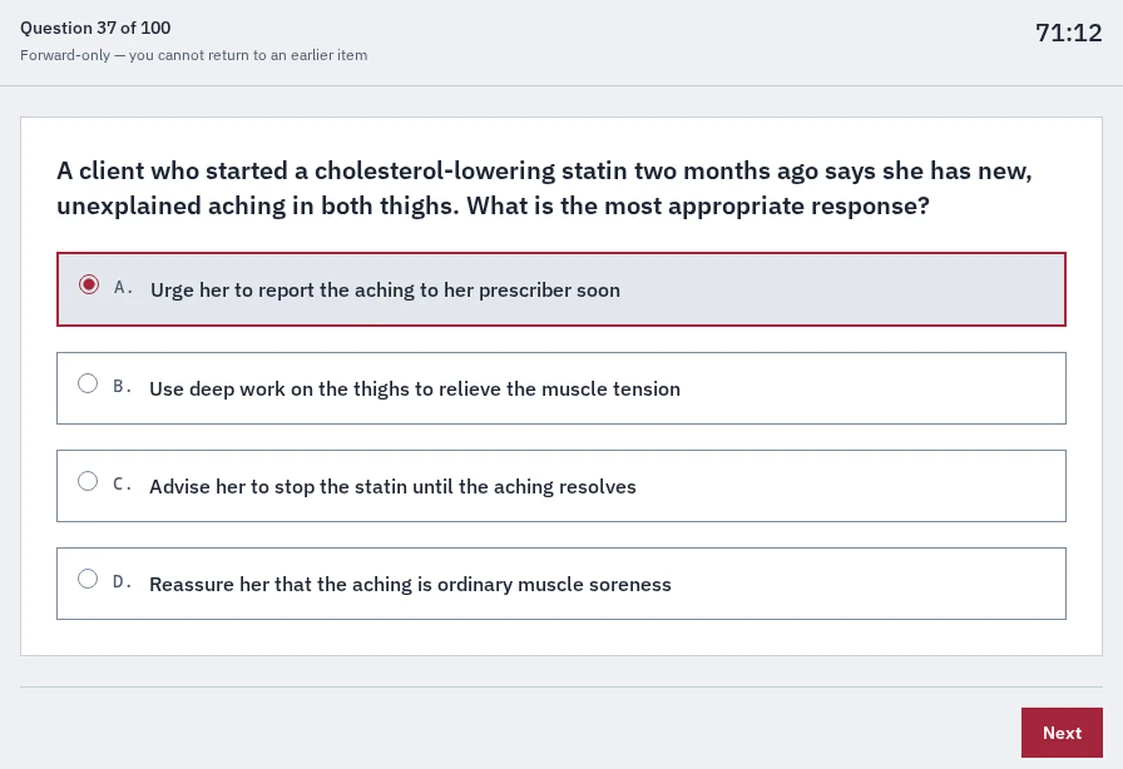
No going back. You can't skip a hard question and return to it. Every question gets your answer before you press Next, so a "come back later" habit trains the wrong reflex.
Finish, always. 110 minutes for 100 questions is just over a minute each. Candidates often report finishing well inside the limit, many in 35 to 60 minutes. Don't bank on it: a blank at the end means an unfinished exam, and that's a fail.
Expect it to feel hard. Many candidates report feeling like they were failing the whole way through, then passing. A hard question is not a verdict. Keep moving.
The quickest way to feel these rules is to practice under them: take the free full-length MBLEx practice test.
Try one question
Practice question written by LMTPrep, not taken from the MBLEx.
After a muscle is lengthened during a stretch, it recoils to its resting length once released. This property of muscle tissue is called:
The seven MBLEx content areas
FSMTB's content outline (© FSMTB 2023, built on its 2022 job task analysis of more than 5,000 respondents) splits the exam into seven areas. FSMTB labels the percentages approximate.
| Content area | Weight | What it covers |
|---|---|---|
| Anatomy & Physiology | 11% | Body systems; tissue injury and repair; concepts of energetic anatomy |
| Kinesiology | 12% | Muscle attachments and actions; proprioceptors; joints; active, passive and resisted range of motion |
| Pathology, Contraindications, Areas of Caution, Special Populations | 14% | Pathologies; contraindications; areas of caution; special populations; classes of medications |
| Benefits and Effects of Soft Tissue Manipulation | 15% | Physiological and psychological effects; strokes and sequence; hot and cold applications; modalities |
| Client Assessment, Reassessment & Treatment Planning | 17% | Intake and health history; written data collection; visual, palpation and range-of-motion assessment; clinical reasoning |
| Ethics, Boundaries, Laws, Regulations | 16% | Boundaries; dual relationships; sexual misconduct; laws and scope of practice; confidentiality |
| Guidelines for Professional Practice | 15% | Hygiene, sanitation and safety; body mechanics; draping; business practices and records; terminology |
Read the weights before you plan anything. Client Assessment (17%) and Ethics (16%) together are a third of the exam, more than Kinesiology and Anatomy & Physiology combined (23%). Energetic anatomy is still listed under A&P, so don't skip it.
Candidates often report that kinesiology feels heavy ("identify the muscle" items), that business and tax questions catch them off guard, and that several answers can look right. We wrote deeper guides for two dense areas: MBLEx kinesiology and MBLEx pathology and contraindications.
FSMTB revisits the outline through a job task analysis every five to seven years and has announced no change to the current one.
Scoring, cost and retakes
Pass or fail, and nothing else
"Examination results are reported as PASS or FAIL." That's the handbook, and it's the whole story. Passing means meeting a criterion-referenced standard set by the FSMTB Board. FSMTB publishes no numeric score, no scale and no cut score.
Pass, and you see an on-screen message (in place since August 1, 2024). Fail, and you get a diagnostic report broken down by content area. Either way, your result goes to the state board you chose within five business days. Nothing is posted online.
The commonly published claim: a widely used prep publisher prints a numeric scale and a minimum score to pass. What FSMTB says: pass or fail, and no scale appears in the 2020, 2023, 2025 or 2026 handbooks. More in why there's no published MBLEx passing score and what MBLEx prep sites get wrong. FSMTB does publish pass-rate figures in its annual reports.
What the MBLEx costs
- $265 per attempt, paid with your application to FSMTB. The fee is nonrefundable and nontransferable.
- FSMTB verifies your education and processes the application within five business days. The application stays valid for six months.
- Once you receive your Authorization to Test (ATT), you have 120 days to take the exam. You book with Pearson VUE.
- Miss the appointment and your ATT expires: you reapply and pay $265 again. Rescheduling carries consequences too, so check the current Candidate Handbook before you move a date.
- Sending your result to another board costs $40.
The full breakdown, including FSMTB's own study products, is on our MBLEx exam cost page.
If you don't pass
You can reapply right away. FSMTB's FAQ says you "may submit a new application for the MBLEx immediately," and every attempt costs $265. FSMTB sets no attempt limit, but your state board may. Older guides still repeat a 30-day rule that was last printed in the July 2023 handbook. Ignore it. Once you've passed, retesting is allowed only with your board's written permission.
The diagnostic report is the asset: it tells you which content areas to rebuild. Our MBLEx retake guide turns it into a plan.
How to prepare for the MBLEx
Test early, study by area in proportion to the outline, test again. Our four-week MBLEx study guide lays it out week by week; here's the shape.
- Take a full timed run first. You want a baseline by content area, not a feeling.
- Study in proportion to the weights. Client Assessment and Ethics get the most time, then shift toward whatever your baseline marked weak.
- Learn untimed, test timed. Untimed practice by content area is for learning; full timed runs are for measuring.
- Re-test under exam conditions in the final week, then repair the weakest heavy area.
We built LMTPrep's simulator around those rules: 100 questions, 110 minutes, one at a time with no going back, weighted to the seven content areas of FSMTB's outline, then broken down by content area, the way the MBLEx's own diagnostic report breaks down a failing score. In our simulator, the clock never pauses, there's no calculator, and any question unanswered at 0:00 counts as wrong. The real MBLEx adapts which questions you get; our practice form is a fixed set weighted the same way.
Each run ends with a readiness band from our documented model: Ready at 90% or more, Borderline at 70–89%, Not ready yet below 70%. It's a study signal, not a prediction, because FSMTB reports pass or fail only. See our scoring method.
We wrote every question ourselves to FSMTB's published outline: three full forms with 300+ original questions, a worked explanation on every one, plus an untimed practice mode by content area. None of it comes from the actual exam, and no legitimate prep provider has that content: FSMTB's handbook says sharing exam questions, including ones recalled from memory, is illegal.
FSMTB sells its own practice exam too: MBLEx Check, $25, 100 timed questions weighted like the outline, which FSMTB calls "the only FSMTB-authorized practice exam."
Your first full timed run on LMTPrep is free with an account. Paid plans are Starter at $29 and Elite at $49, one-time, with a 7-day money-back guarantee (see pricing).
Take the free full-length MBLEx practice test
MBLEx FAQ
Quick answers below; the full list is on our MBLEx FAQ page.
What does MBLEx stand for?
MBLEx stands for Massage & Bodywork Licensing Examination. The name is a registered mark of the Federation of State Massage Therapy Boards (FSMTB), which first administered the exam in July 2007.
Does passing the MBLEx give me a massage license?
No. FSMTB's handbook says passing "does not result in a certification or credential of any kind." Your result goes to the state board you chose, pass or fail, and the board issues the license once you meet its other requirements, which can include extra steps such as the Texas Jurisprudence Exam or Florida's 10-hour laws and rules course.
How long do I have to take the MBLEx after I apply?
FSMTB processes applications within five business days, and an application stays valid for six months. Once you receive your Authorization to Test (ATT), you have 120 days to take the exam at a Pearson VUE test center. Miss your appointment and the ATT expires, so you would reapply and pay the $265 fee again.
Can I retake the MBLEx right away if I fail?
Yes. FSMTB says you "may submit a new application for the MBLEx immediately," and each attempt costs $265. FSMTB sets no attempt limit, but your state board may set one.
Written by Tom Prescott for LMTPrep. Facts checked against FSMTB's MBLEx Candidate Handbook (effective September 17, 2026) and fsmtb.org on October 8, 2026.