MBLEx Study Guide: A Four-Week Plan Built on FSMTB's Outline
A good MBLEx study plan spends your time in proportion to FSMTB's content outline, which puts Client Assessment (17%) and Ethics (16%) at the top. It also trains you under the exam's actual rules: 100 questions, 110 minutes, one at a time, no going back.
Below: the four-week plan, how to split timed runs from untimed practice, how to read your results, and the last 48 hours. New to the exam itself? Start with what the MBLEx is and how it works.
The four-week MBLEx study plan
The plan follows the content outline FSMTB publishes, biggest areas first. FSMTB calls its percentages approximate; our simulator uses them as exact question counts on every 100-question form.
| Content area | Share of the MBLEx |
|---|---|
| Client Assessment, Reassessment & Treatment Planning | 17% |
| Ethics, Boundaries, Laws, Regulations | 16% |
| Benefits and Effects of Soft Tissue Manipulation | 15% |
| Guidelines for Professional Practice | 15% |
| Pathology, Contraindications, Areas of Caution, Special Populations | 14% |
| Kinesiology | 12% |
| Anatomy & Physiology | 11% |
Less than four weeks? Keep the order and compress. Your baseline can also reorder it: a lighter area that comes back Weak moves up.
Week 1: baseline, then the two biggest areas
Day 1 is a full timed run, cold, so you start from a real baseline instead of a guess. The free full-length MBLEx practice test gives you that first run.
Then go to the top of the outline. Client Assessment (17%): session organization, intake and health history, written data collection, visual, palpation and range-of-motion assessment, and clinical reasoning such as ruling out contraindications and setting goals. Ethics (16%): boundaries, dual relationships, sexual misconduct, laws, scope of practice and confidentiality. Candidates often report tricky ethics wording, with several answers that look right. Practice picking the best answer, not merely a defensible one.
Week 2: technique and professional practice
Benefits and Effects (15%): physiological and psychological effects, strokes and their sequence, hot and cold applications, and modalities. Candidates report niche items here, such as stone therapy.
Professional Practice (15%): hygiene, sanitation, safety, body mechanics, draping, business practices and records, and terminology. Candidates often say the business and tax questions surprised them. Don't let them surprise you.
End the week with a second full timed run on a new form and compare it, area by area, with your baseline.
Week 3: pathology, kinesiology, anatomy
Pathology (14%): pathologies, site-specific and other contraindications, areas of caution, special populations and classes of medications, which candidates report seeing. Go deeper with our MBLEx pathology and contraindications guide.
Kinesiology (12%): muscle attachments and actions, proprioceptors, joints, and active, passive and resisted range of motion. Candidates often call this area heavy, especially "identify the muscle" items. Work through our MBLEx kinesiology guide.
Anatomy & Physiology (11%): body systems, tissue injury and repair, and concepts of energetic anatomy, which are still on the outline.
Week 4: exam conditions, then targeted repair
Take your third full timed run early in the week. Spend the remaining days in untimed practice on whatever came back Weak or Borderline, heaviest areas first.
A free account includes one full timed run. Our paid plans, Starter at $29 and Elite at $49, are one-time payments with a 7-day money-back guarantee (see pricing). On the free run only? FSMTB's own MBLEx Check ($25, 100 timed questions weighted like the outline) works as a later full check.
Timed full runs vs untimed practice mode
They do different jobs. Mix them up and you waste practice forms.
Timed full runs measure. In our simulator, the clock runs 110 minutes and never pauses, questions come one per screen, there's only a Next button and no calculator. At 0:00, unanswered questions count as wrong and the run is marked incomplete, mirroring how the MBLEx fails an unfinished exam. We have three full forms, so make each run one you haven't seen. Repeating a form measures memory, not readiness.
Untimed practice mode teaches. Pick a content area, answer at your own pace, and read the worked explanation after every question. Most of your four weeks belong here. It's deliberately separate from the simulator: no clock, no test conditions.
Never take a timed run without reviewing every miss afterward. That review is half the value.
How to read your per-area breakdown
Each full run is scored as percent correct overall and per content area, with time used and unanswered questions. Our documented model labels the run Ready (90% or more), Borderline (70–89%) or Not ready yet (below 70%, or incomplete), and each area Strong, Borderline or Weak on the same cut-points. It's a readiness estimate from our model, not an MBLEx result: FSMTB reports pass or fail only. Method on our scoring method page.
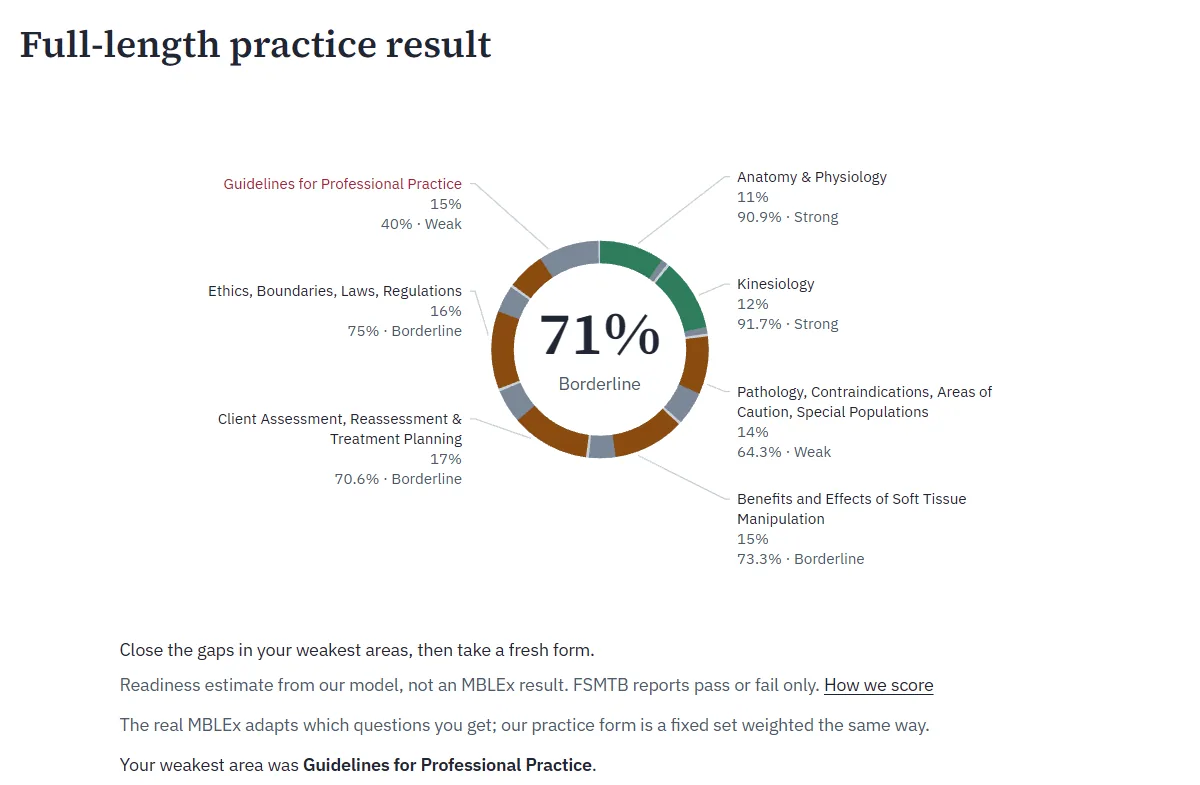
Read it in this order:
- Unanswered questions first. If you ran out of time, pacing is your first problem.
- Weight the gaps. Miss 5 of 17 in Client Assessment and 3 of 11 in A&P: both read Borderline (about 71% and 73%), but one cost you 5 questions and the other 3. Fix the heavy area first.
- Find the subtopic. Wrong on every range-of-motion item? Drill that in practice mode instead of rereading the whole area.
- Compare runs, not single scores. The real MBLEx adapts which questions you get; our practice form is a fixed set weighted the same way. Two or three runs pointing the same direction is a signal.
FSMTB's diagnostic report for a failed exam is broken down by content area too, so the same habit applies. Our MBLEx retake guide covers it.
Test-day rules that should change how you practice
You can't go back. No skipping, no flagging, no returning; you can change an answer only before you move on. A professional association's study page still tells candidates to flag a question and come back to it. Pearson VUE's FSMTB exam page says: "Flagging exam questions for later review is not permitted on the MBLEx." Practice committing: read, decide, Next.
The clock never stops. No scheduled breaks, and the clock keeps running if you step out. Do every timed run in one sitting, phone in another room.
No calculator. Calculators are prohibited items. Practice without one.
Every question must be answered. An unfinished exam is a fail with no diagnostic report. Candidates often report finishing with time to spare, many in 35 to 60 minutes. Plan to finish anyway: if a question stalls you, choose the best option and move.
Expect it to feel hard. Many candidates report feeling like they were failing the whole time, then passing. A run of tough questions is not a verdict.
Want to feel all of this before test day? Take the free full-length MBLEx practice test.
The last 48 hours
Stop learning new material. Two days out, the job is review and logistics.
- Review, don't cram. Reread the explanations for questions you missed on your full runs, weakest heavy area first.
- Skip a full run the night before. You won't fix anything in a day, and a bad number costs sleep.
- Check logistics. Your appointment must fall within the 120 days on your Authorization to Test (ATT). It lasts 120 minutes: a 5-minute agreement, 110 minutes of exam, a 5-minute survey.
- Don't miss it. A missed appointment means your ATT expires and you reapply and pay $265 again. Rescheduling carries consequences too, so check the current Candidate Handbook before changing anything.
Afterward: pass, and you see an on-screen message. Fail, and you get a diagnostic report by content area and can reapply immediately. Either way, your result goes to your state board within five business days.
MBLEx study guide FAQ
Does FSMTB publish its own MBLEx study guide?
Yes. FSMTB sells an e-Study Guide for $35 that includes a 100-question practice exam with answers, and a print guide for $39.95. Its practice exam, MBLEx Check, costs $25. FSMTB names no third-party prep provider, and LMTPrep is not affiliated with FSMTB.
What should I study most for the MBLEx?
Client Assessment, Reassessment & Treatment Planning (17%) and Ethics, Boundaries, Laws, Regulations (16%), the two largest areas on FSMTB's outline and about a third of the exam together. After that, let your per-area results decide: a Weak area moves up whatever its weight.
Can I use a calculator on the MBLEx?
No. Calculators are prohibited items on the MBLEx, so practice without one. Our simulator has no calculator either.
How many full practice tests should I take before the MBLEx?
We suggest three full timed runs over four weeks (day 1, end of week 2, early week 4), each on a form you haven't seen. LMTPrep has three full forms for exactly that. Spend the time in between in untimed practice by content area.
Written by Tom Prescott for LMTPrep. Facts checked against FSMTB's MBLEx Candidate Handbook (effective September 17, 2026) and fsmtb.org on October 8, 2026.